
Briefly explained
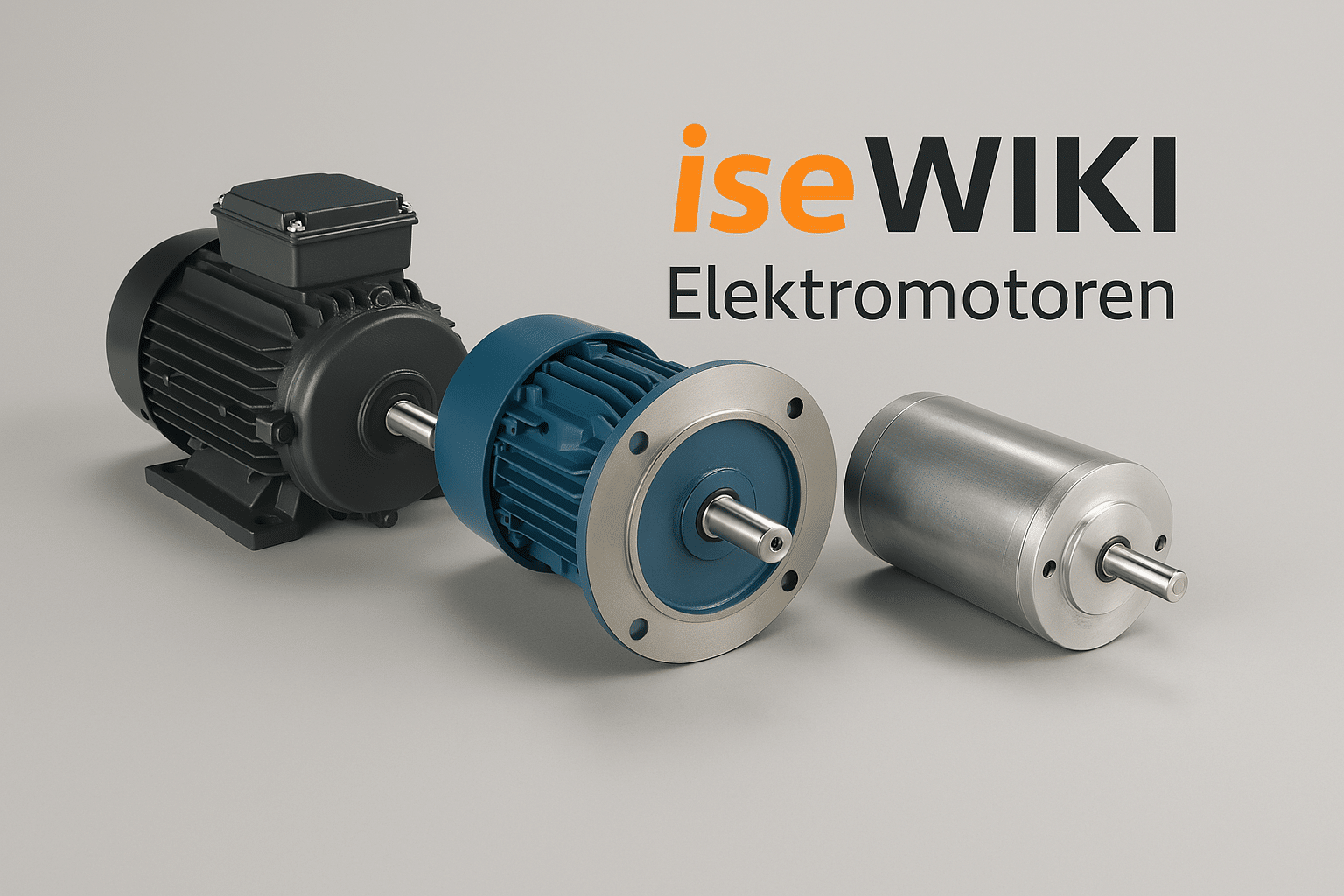
An electric motor converts electrical energy into rotary motion. This rotation drives machines, devices or axes. The basic principle is the interaction between electric current and magnetism: when current flows through a coil, it generates a magnetic field that acts on a rotor, causing it to turn.
Electric motors operate reliably and efficiently and can be manufactured in many sizes and designs. They are now indispensable in industry, households, transport and the trades.
How an electric motor works
In each electric motor, the so-called Lorentz force acts. It occurs when an electrical conductor is in the magnetic field and current flows. This force generates a torque that sets the rotor in motion.
A fundamental distinction is made between DC and AC motors. These two groups are again divided into several subtypes, which differ in design, control and application.
Direct-current motors (DC motors)
DC motors operate at a constant voltage, for example from batteries, power supplies or regulated power sources. The rotational movement is caused by electromagnetic forces between the rotor and a stationary magnetic field.
There are two main types:
Brushed DC motor
This traditional design uses sliding contacts, or brushes, and a commutator to reverse the polarity of the rotor coils, producing continuous rotation.
Typical applications:
– Cordless screwdrivers
– Toys
– Electric car windows
– Simple conveyor systems
Brushless DC motor (BLDC)
Commutation takes place electronically, without mechanical contacts. This increases service life and reduces maintenance. The rotor usually contains permanent magnets, while the stator windings are actively controlled.
Typical applications:
– Fans and pumps
– Drones and model aircraft
– Medical devices
– High-precision 3D printers
DC motors are easy to control, have good starting characteristics and often deliver high starting torque. Brushed versions, however, require more maintenance and have a shorter service life.
Alternating-current motors (AC motors)
AC motors operate from the mains supply, for example at 230 V for single-phase or 400 V for three-phase supplies, depending on the country. Rotating magnetic fields in the stator set the rotor in motion. Three designs are important here:
Induction motor (squirrel-cage motor)
This robust motor design uses a short-circuited rotor. It runs slightly slower than the stator’s rotating magnetic field, hence the alternative name “asynchronous motor”.
Typical applications:
– Ventilation and air-conditioning systems
– Industrial pumps
– Conveyor belts
– Compressors
Synchronous motor
The rotor turns in synchronism with the magnetic field. Its field is generated either by permanent magnets or by a separate excitation current.
Typical applications:
– Modern machine tools
– Packaging machinery
– Precision winding and cutting equipment
Single-phase motor
A compact motor for household and small appliances. It often uses a capacitor for starting and provides moderate power.
Typical applications:
– Kitchen appliances
– Smaller pumps
– Building ventilation systems
AC motors are durable and require little maintenance. Their control is more complex, however, particularly for variable speed or positioning.
Stepper motor
A stepper motor is technically a synchronous machine. It moves in defined angular steps rather than continuously. Each control pulse produces a small angular movement, allowing movement to be controlled by counting steps, even without a sensor.
Typical applications:
– 3D printers, for example X, Y and Z axes
– Machine positioning systems
– Labelling and filling equipment
– Laboratory automation
Stepper motors are ideal for moderate torque requirements and simple positioning tasks. Combining them with an encoder creates a highly accurate closed-loop system.
Servomotor
A servomotor combines a motor, sensors and closed-loop control. Feedback of the actual position, for example from an encoder, allows the system to respond precisely to deviations and correct movements dynamically.
Typical applications:
– Robot axes
– Milling and laser systems
– High-speed packaging machines
– High-precision machine tools
Servo drives are very precise and dynamic, but also complex and expensive to purchase.
Electric motor: differences at a glance
- DC motors: easy to control, but subject to wear in brushed versions
- AC motors: robust, durable, less precise without additional technology
- Stepper motors: ideal for simple, exact positioning
- Servomotors: highest accuracy in complex movements
- BLDC: efficient, maintenance-free and suitable for continuous operation
The choice depends on the application, load, required control and economic considerations.
iseCONTROL: the right controller for electric motors
iseCONTROL was developed for industrial applications with stepper motors. The controller supports microstepping, encoder connectivity and communication via PROFINET and PROFIBUS. It enables precise motion without the complexity of traditional servo systems.
Flexible configuration makes iseCONTROL suitable for many machine designs, particularly series-production machines where compact construction, reliability and easy commissioning are essential.
Practical examples include our EG2-Box and EK2-Box , which are used as marking controllers, for example in Borries punch-marking machines.
Conclusion
An electric motor is a core component of modern technology. It moves machines, devices and entire production plants – reliably, efficiently and with low maintenance.
There are many designs, from simple DC motors and AC machines to high-precision servo drives. Each has its ideal application. With a suitable controller such as iseCONTROL, an intelligent solution can be developed.
Electric motors set technology in motion. And anyone who wants to control this movement needs the right knowledge – and the right system.