
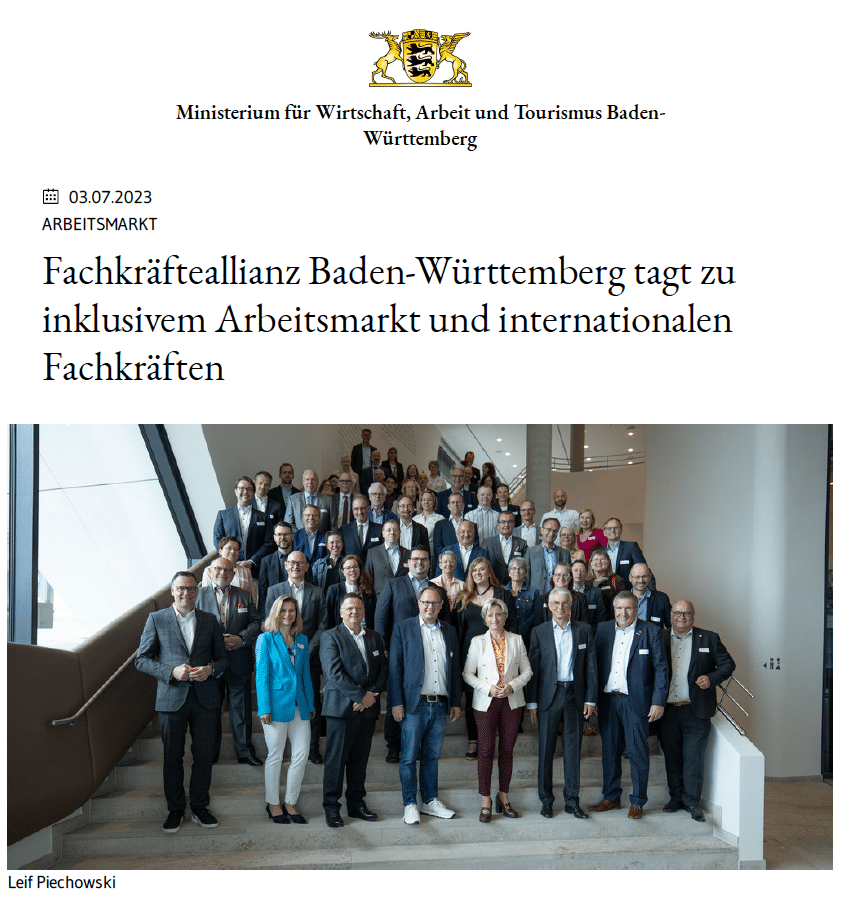
The Ministry of Economic Affairs is investing more than €80 million this year to address the growing shortage of skilled workers over the long term. The Fachkräfteallianz, an alliance of representatives from business, education and government working together on effective solutions, plays a central role. At the latest conference on securing a skilled workforce, Minister of Economic Affairs Dr Nicole Hoffmeister-Kraut emphasised the importance of cooperation and set out clear prospects for the future.
Dr Nicole Hoffmeister-Kraut: greater inclusion and a shared effort
Dr Nicole Hoffmeister-Kraut opened the conference with a strong appeal to companies and public institutions. She stressed that companies should employ more people with disabilities to help address skills shortages. Successful examples show that workplace inclusion benefits everyone involved: it supports the individuals concerned and strengthens the company's culture as a whole.
According to Dr Hoffmeister-Kraut, investment in inclusion is part of the Fachkräfteallianz's long-term strategy. She highlighted the need for a shared effort to realise everyone's full potential and tackle the shortage of skilled workers effectively.
isepos GmbH: an example of successful inclusion and workforce development
At the conference, Martin Singer, Managing Director of isepos GmbH, also demonstrated how inclusion can succeed in practice. In his presentation, he described in detail how his company successfully integrates skilled employees with disabilities and offers them secure, long-term employment.
Singer stressed that the inclusive culture at isepos is firmly embedded in everyday business practice. The company’s experience shows that employing people with disabilities brings social and tangible economic benefits. According to Singer, these positive effects make a compelling case for companies to do more to support inclusion.
Key topics for the Fachkräfteallianz: vocational training, continuing education and digitalisation
Another major focus of the conference was an in-depth exchange on new vocational training and continuing education programmes. Representatives of the Fachkräfteallianz discussed how educational institutions and businesses could work more closely together to prepare skilled workers more specifically for the needs of the economy.
Digitalisation plays a crucial role. Digital technologies enable flexible, efficient training formats that make qualifications more accessible. The Fachkräfteallianz specifically helps companies integrate digital tools into their training strategies so they can develop employees' skills more quickly and sustainably.
Cooperation is central to the Fachkräfteallianz
Experts within the Fachkräfteallianz agree that tackling the shortage of skilled workers requires close, trusting cooperation between businesses, schools, universities and public authorities. Regular meetings and workshops play an important role in presenting and sharing successful solutions.
Sharing examples of good practice, such as isepos GmbH, gives other companies guidance. Successful approaches can then be adopted and implemented quickly and efficiently. These connections help keep the region attractive as a place to do business and secure its skilled workforce over the long term.
Infrastructure and working conditions: key topics for the Fachkräfteallianz
Alongside education, the Fachkräfteallianz considers the wider conditions that matter to skilled workers. These include good transport links, digital infrastructure and attractive working conditions. Such factors strongly influence whether people want to stay in a region over the long term.
The alliance therefore advocates investment in infrastructure and mobility to help attract and retain skilled workers. Good conditions are essential to maintaining a skilled workforce over the long term.
Attracting skilled workers from abroad: another pillar of the Fachkräfteallianz
Another focus is recruiting skilled workers internationally. Global competition for talent means looking abroad for qualified employees as well. The alliance offers targeted support to companies that want to integrate skilled workers from other countries.
Advice, integration support and practical guidance help companies bring international employees into their teams effectively. International expertise also brings cultural diversity, which many companies see as an asset.
Success stories supported by the Fachkräfteallianz
Numerous examples already demonstrate the positive impact of the Fachkräfteallianz. Companies report that new vocational training and continuing education initiatives have helped them recruit qualified employees. Support for introducing digital learning formats is proving particularly effective.
isepos GmbH is a concrete example of how successful inclusion can help secure a skilled workforce. The company is often cited as a positive role model, encouraging other businesses to take a similar approach.
Looking ahead: working together to secure a skilled workforce
At the end of the conference, Dr Nicole Hoffmeister-Kraut summarised the Fachkräfteallianz's aims and achievements. She made clear that long-term solutions require sustained cooperation between government, business and education. The alliance aims to make the region attractive to skilled workers while considering all groups in society.
Participants agreed that the alliance had already made valuable contributions, but major challenges remained. Together, they intend to keep developing innovative solutions to tackle the shortage of skilled workers actively and sustainably.