
Briefly explained
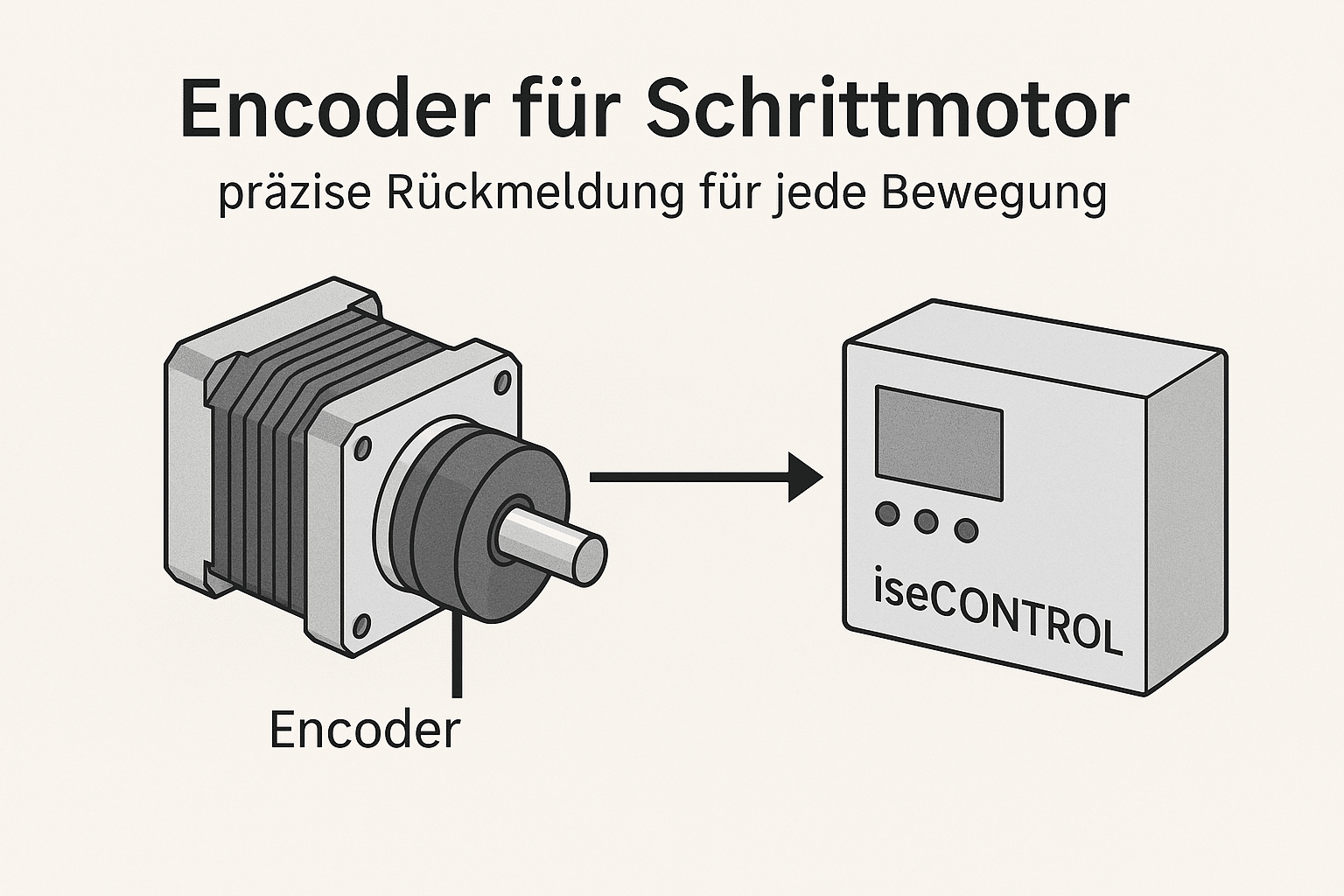
A stepper motor encoder is a sensor that measures how far the motor shaft has actually turned. It sends a precise feedback signal to the controller, allowing the controller to check whether the motor has reached the requested position.
In a conventional system without an encoder, a stepper motor operates in open loop. It follows commands without checking whether every step has been completed correctly. This is often sufficient for simple applications. When accuracy matters, or friction and changes in load affect the drive, missed steps can occur. The motor can lose synchronisation, causing the machine to produce faulty parts or stop.
An encoder closes this gap by adding feedback to the drive. The resulting closed-loop system detects deviations immediately and can respond, improving precision, reliability and fault tolerance.
This is particularly useful in applications such as CNC milling, 3D printing, handling systems and special-purpose machinery.
How an encoder provides precise feedback
An encoder is mounted on the motor shaft or directly on the stepper motor. It measures motor movement and transmits that information as electrical signals.
There are incremental and absolute encoders. Incremental encoders generate pulses from which movement can be determined. Absolute encoders provide the exact position at any given time.
The controller receives these signals and compares them with the setpoint. If actual and requested values match, the movement is correct. If they differ, the controller can respond, for example by repeating a step, issuing an error message or stopping the process.
This creates a closed control loop that operates more reliably than a purely open-loop system.
Why feedback matters for stepper motors
Without feedback, a stepper motor depends on suitable operating conditions for reliable operation. External influences such as varying loads, mechanical backlash or high acceleration increase the risk of missed steps.
Missed steps can have serious consequences: a position is incorrect, parts are machined wrongly and the process loses synchronisation.
An encoder detects errors early, helping prevent damage, downtime and scrap. The machine can operate more consistently and reliably and often faster, because operating margins can be reduced. This is a major advantage of closed-loop operation.
iseCONTROL provides control and reliability
iseCONTROL is a controller developed specifically for use with encoders. It processes feedback signals directly and without delay.
Key benefits:
- Real-time evaluation of encoder signals
- Immediate response to missed steps
- Stable operation under changing loads
- Suitable for demanding industrial applications
- Straightforward integration into existing machine designs
iseCONTROL combines the simplicity of a stepper motor with the operational reliability of a servo system, without its complexity or cost.
Benefits at a glance
A stepper motor with an encoder and intelligent controller offers several advantages:
- Improved positioning accuracy
- Early fault detection
- Greater process reliability
- Reduced maintenance requirements
- Less scrap and machine downtime
- No additional feedback system required
This solution is particularly attractive to manufacturers of standard production machines seeking a reliable, cost-efficient drive system.
Is an encoder worthwhile?
In many cases, yes. An encoder improves accuracy and makes the overall system more robust. The benefits are particularly apparent in industries where quality, repeatability and dependable operation matter.
With a suitable controller such as iseCONTROL, integration is straightforward and requires little additional effort. The technology is mature, proven in practice and already standard in many applications.
A stepper motor encoder measures the exact position of the motor shaft. It records how far the shaft has turned and sends this information to the controller. This turns an open-loop drive into a closed-loop system, giving the controller feedback on whether the motor moved as intended.
Stepper motors conventionally operate in open loop. They execute the commanded steps without checking the actual movement. This is often enough for simple applications. When precision matters or influences such as friction, load changes or temperature come into play, missed steps can occur. These lead to inaccurate positions, faulty processes or, in the worst case, scrap.
An encoder provides the missing feedback so the controller can check each movement. It immediately detects whether the motor has responded as expected and can intervene when necessary. This improves accuracy and process reliability while reducing failures.
Using an encoder on a stepper motor
An encoder is mounted directly on the stepper motor shaft. Depending on the type, it measures rotational speed using incremental signals or exact position using absolute signals. The signals are sent to the controller in real time, where they are evaluated and compared with the setpoints.
If actual movement differs from the requested movement, the controller can react immediately. It can stop the machine, correct the position or initiate a defined fault response, helping prevent faulty parts and incorrectly executed processes.
This matters especially in industrial applications such as CNC machines, 3D printers and packaging equipment. A stepper motor encoder provides precision and reliable operation with less complexity than conventional servo drives.
iseCONTROL: the controller for stepper motors with encoders
Our iseCONTROL controller is optimised for stepper motors with encoders. It processes encoder signals directly and without delay, creating a closed-loop system with precise position feedback.
iseCONTROL automatically detects missed steps. The controller can respond before an error disrupts the subsequent process. This saves time, reduces scrap and makes the overall operation more robust.
Combining a stepper motor, encoder and iseCONTROL creates a capable drive system without the complexity of an expensive servo drive. It is particularly attractive to manufacturers of standard production machines seeking an affordable, reliable, low-maintenance solution.
Advantages of a stepper motor with an encoder
The main technical benefits are:
- Real-time feedback
- Detection and correction of missed steps
- Greater precision in repeated movements
- Improved stability under changing loads
- Reduced maintenance through monitoring
- No expensive servo technology required
An encoder is particularly worthwhile where positioning requirements are demanding. The stepper motor remains compact and straightforward, while feedback significantly improves its performance.
Why a stepper motor encoder is worthwhile
An encoder is no longer a luxury for stepper motor applications. In many applications, feedback is essential for avoiding errors and achieving reliable, repeatable processes.
With the right controller, such as iseCONTROL, a stepper motor with an encoder can be integrated easily into existing systems. The benefits in reliability, accuracy and ease of maintenance speak for themselves.