
Briefly explained
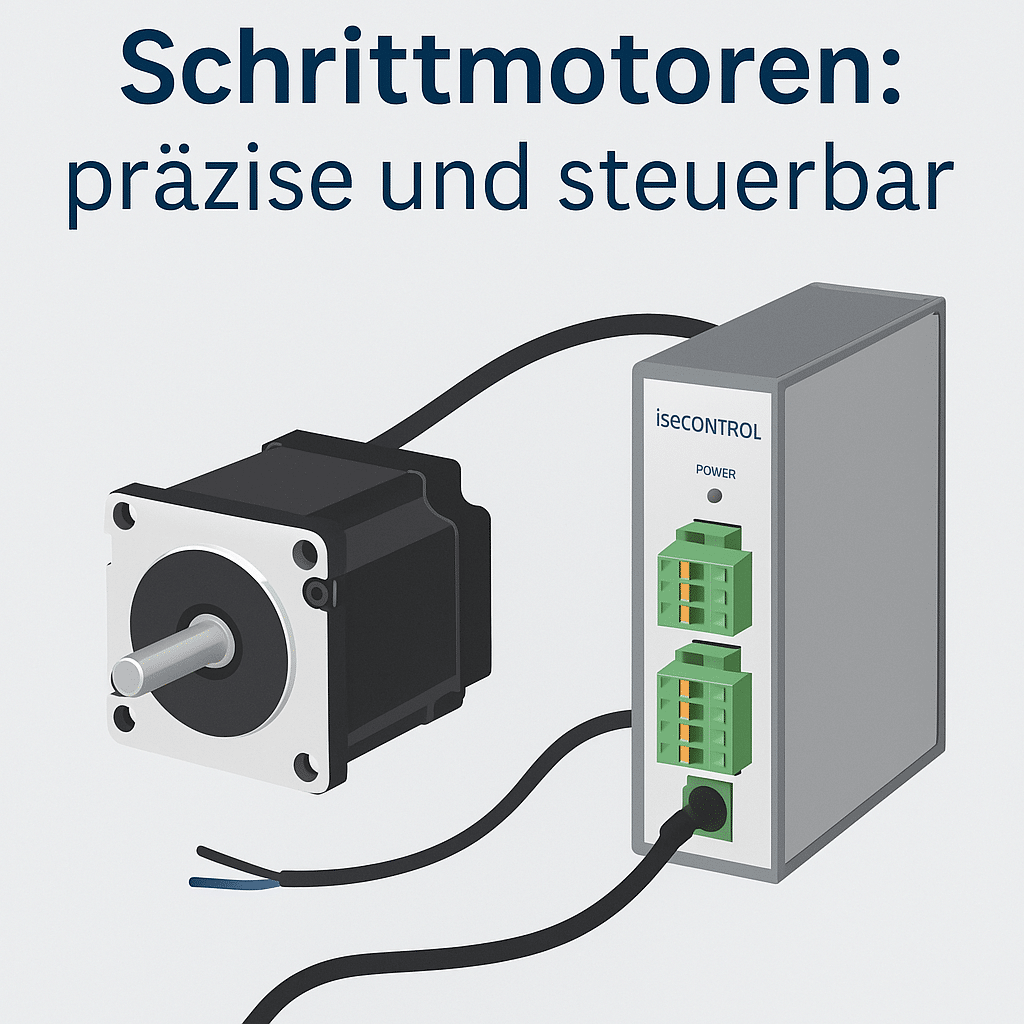
A stepper motor is an electric motor that rotates in small, defined steps rather than as one continuous movement. Each step can be controlled precisely, allowing accurate motion without expensive sensors or elaborate feedback systems.
Stepper motors are used wherever accurate, repeatable positioning matters. Examples include an axis in a 3D printer, a feed mechanism in a CNC machine or a dispensing system in packaging equipment.
The English term “stepper motor” is also widely used in German technical language.
How does a stepper motor work?
Electrical pulses control the motor. Each pulse advances the rotor by a fixed angle, for example 1.8 degrees. At that step angle, 200 pulses produce a complete 360-degree revolution.
Controlling the windings in a defined sequence determines direction, speed and position. The controller counts the steps. In many applications, this is sufficient to achieve the required accuracy.
When greater precision is needed, the motor can use microstepping or an encoder. These approaches support especially smooth movements.
Benefits of stepper motors
Stepper motors offer several benefits, particularly in industry:
- Precise positioning without a sensor
- Repeatability with each movement
- Cost efficiency compared with servo motors
- Simple control using digital signals
- High holding torque at standstill
- Low maintenance requirements thanks to robust construction
These advantages make stepper motors a first choice for many manufacturers of standard production machines, from medical technology to automation.
Applications for stepper motors
Typical applications include:
- 3D printers (X, Y and Z axes, extruders)
- CNC milling and turning
- Labelling and packaging machines
- Conveyor equipment and positioning units
- Automated dispensing and mixing systems
- Robot arms and pick-and-place systems
Where repeatability, reliability and straightforward control matter, stepper motors are a sound choice.
Our solution: stepper motors with iseCONTROL
Good stepper motor control requires carefully designed electronics. Our iseCONTROL controller was developed specifically for industrial stepper motor applications.
It provides:
- Precise stepper motor control
- Support for microstepping and encoders
- Monitoring for missed steps and overcurrent
- A compact design for the control cabinet
- Straightforward integration through standard interfaces
iseCONTROL enables efficient, dependable integration of stepper motors into a wide range of machine designs.
Practical examples include our EG2-Box and EK2-Box, used as marking controllers for equipment such as Borries marking machines.
Stepper motor or servo motor?
The choice depends on the application.
A stepper motor is ideal when:
- Motion must be controlled but does not require very high dynamics
- Costs need to remain low
- The system should be simple and require little maintenance
A servo motor is worthwhile when:
- Very high rotational speeds are needed
- Large loads must be accelerated
- Closed-loop control is required
An encoder can also turn a stepper motor system into a closed-loop system, combining benefits of both approaches. This works particularly well with iseCONTROL.
Stepper motors: versatile, precise and reliable
Stepper motors are an essential part of modern industry. They offer a straightforward way to control movement precisely without complex feedback systems.
Whatever term is used, the technology offers accuracy, durability and good value for money. With a suitable controller such as iseCONTROL, it enables flexible, future-ready solutions for machine automation.