
Briefly explained
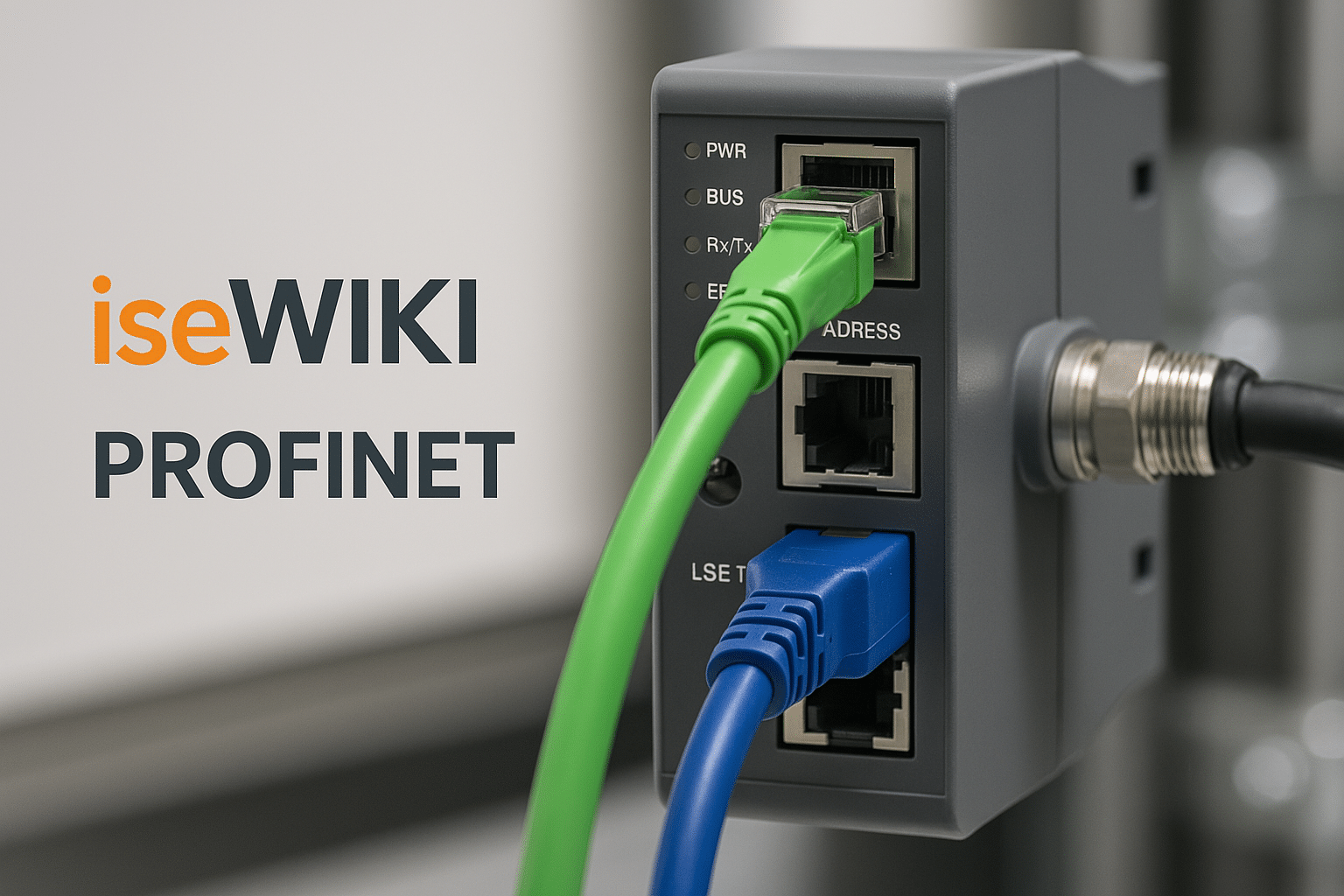
PROFINET is an open standard for industrial communication. It enables machines, controllers, sensors and other components to communicate reliably and in real time. The technology is based on Ethernet, but has been developed specifically for the requirements in automation.
Unlike traditional fieldbuses such as PROFIBUS, PROFINET uses modern networking technology. This makes it flexible to deploy, quick to expand and easy to integrate into existing machine architectures, explaining its importance in industry.
Especially in complex systems with high demands on speed, timing and data volume, it is today the preferred communication standard.
How does it work?
PROFINET is based on Ethernet communication (IEEE 802.3). It uses standardised cables and network components, many of which have already proved themselves in IT.
At the same time, it meets industrial requirements: data is transmitted robustly, with resistance to interference and within defined time windows. This is especially important when machines must operate together in a fixed cycle, for example in packaging technology or custom machine building.
It distinguishes between two types of data:
- Cyclic data: Transmitted at fixed intervals, for example position values, speeds or switching states.
- Acyclic data: Transmitted as needed, for example for diagnostics or configuration.
PROFINET supports both real-time (RT) and isochronous real-time (IRT) communication. IRT is used when several axes must operate synchronously, as in drive systems.
Where is it used?
PROFINET can be found today in almost all areas of industrial automation. Typical applications are:
- Machine building
- Manufacturing automation
- Process industry
- Packaging equipment
- Assembly and testing systems
- Robotics
- 3D printing equipment
- Marking controllers
- Embossing machine controllers
PROFINET’s flexibility makes it suitable for both small machines and large production lines with hundreds of network devices.
Many manufacturers of controllers, sensors and drives support the standard. This enables communication across manufacturers, a key advantage over closed systems.
Differences between PROFINET and PROFIBUS
PROFIBUS is the direct predecessor of PROFINET. Both standards come from the same development history, but differ significantly in their technology.
| Characteristic | PROFINET | PROFIBUS |
|---|---|---|
| Technology | Ethernet-based | Serial transmission |
| Data rate | Up to 100 Mbit/s and more | max. 12 Mbit/s |
| Topology | Flexible, star, line, ring | Usually line |
| Number of network devices | Very high (several hundred) | Limited |
| Real-time capability | Very high (IRT possible) | Limited |
| Future readiness | High | Decreasing |
Many companies today use both systems in parallel – for example when old systems are modernised or when devices only support PROFIBUS. But in new projects, PROFINET is almost always the first choice.
Benefits of PROFINET
PROFINET offers numerous advantages over older field buses:
- High speed: Data is transmitted within milliseconds.
- Flexible topology: Devices can be connected in line, star or ring.
- Easy to expand: New components can be integrated without great effort.
- Integrated diagnostics: Faults can be identified and resolved more quickly.
- Vendor independence: Many suppliers support PROFINET natively.
- Ready for the future: PROFINET already meets Industry 4.0 requirements.
In addition, PROFINET facilitates central control over SCADA or HMI systems. This creates a continuous flow of information from the sensor to the control room.
iseCONTROL and PROFINET
The iseCONTROL controller was developed specifically for applications requiring high accuracy and reliability. It supports PROFINET natively, without external gateways.
Its integrated PROFINET interface allows iseCONTROL to connect directly to existing networks. Position values, operating states and alarms are sent to the higher-level controller in real time. At the same time, iseCONTROL reliably receives control commands, such as new setpoints, start commands or parameter changes.
This has clear advantages:
- Easy integration into existing control systems
- Fast response times
- Reduced wiring complexity
- Compact design – ideal for the control cabinet
- Shorter commissioning times
In addition, iseCONTROL provides extensive diagnostic functions. This information can be read via the PROFINET network, including remotely. That reduces servicing costs and improves installation availability.
PROFINET in practice: what it means for machine builders
For builders of series-production machines, every centimetre in the control cabinet and every minute during commissioning counts. Every hour of downtime costs money.
PROFINET helps make installations more efficient to plan, faster to build and easier to maintain. Because the standard is widespread, suitable components can be found quickly and equipment from different manufacturers can be used together.
Whether for simple positioning tasks or complex multi-axis control, PROFINET keeps machines flexible, fast and easy to connect. A PROFINET-enabled controller such as iseCONTROL makes implementation particularly straightforward.
Conclusion
PROFINET is today the standard in industrial communication. It is increasingly replacing systems such as PROFIBUS – not only because of its higher performance, but also because of its flexibility, diagnostic capability and ease of use.
Anyone looking to connect machines, installations or components is likely to encounter PROFINET. With a controller such as iseCONTROL, integration is quick, reliable and free of unnecessary complexity. The technology can be implemented in a new machine or as part of an existing automation solution.