
Briefly explained
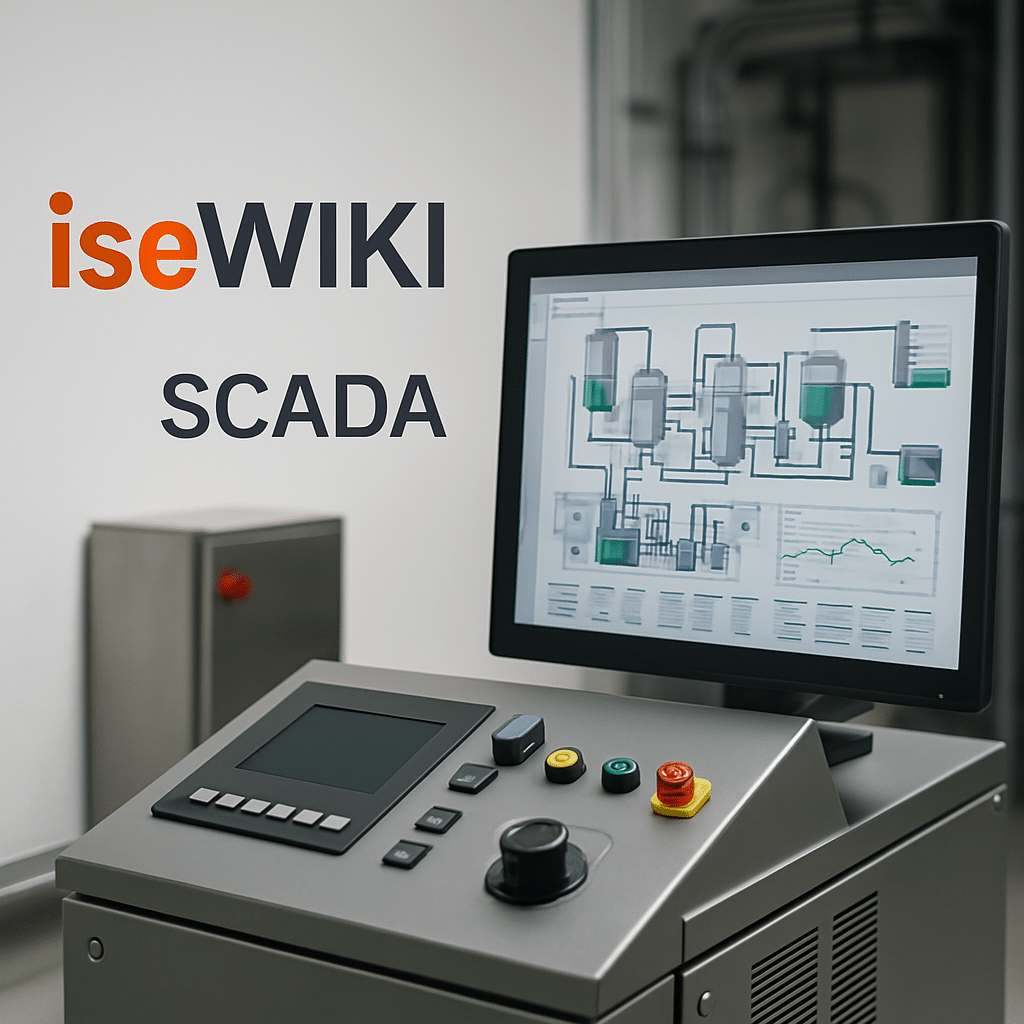
SCADA stands for Supervisory Control and Data Acquisition: monitoring, control and data collection. A SCADA system enables industrial processes to be controlled, monitored and analysed centrally through an intuitive user interface.
In modern production facilities, many sensors, actuators and controllers operate simultaneously. SCADA helps connect these elements. It presents data clearly, allows targeted interventions and stores all relevant information. By supporting central control of industrial installations, SCADA gives machine builders and operators greater control, transparency and operational safety.
Why it is indispensable in industry
Industrial installations are becoming increasingly complex, creating a growing need for continuous process monitoring. SCADA gives operators and technicians a clear overview at all times, regardless of the installation’s size.
For example, the system immediately detects when a limit is exceeded. An alarm message appears and shows exactly where the problem lies. At the same time, the system can automatically trigger a reaction – such as switching off a machine or switching over a valve.
In this way, SCADA contributes to safer, more stable and more efficient operation.
What it is used for
SCADA is used in many areas. These include:
- Production lines in the automotive industry
- Energy supply installations
- Waterworks and sewage treatment plants
- Chemical and pharmaceutical production
- Food processing
- Building technology and infrastructure
Whether it is a small machine or an entire factory, SCADA scales with the requirements. It can be used for an individual process or in a control centre that oversees facilities across several regions.
SCADA system architecture and components
A complete SCADA system consists of several elements that work closely together:
- Sensors and actuators: They record measured values such as temperature, pressure, level or movement and influence processes.
- Controllers (e.g. PLCs): They collect data, make decisions or pass on commands.
- Communication interfaces: This is where the data is transmitted – often via industrial networks such as PROFINET or PROFIBUS.
- Central SCADA software: It visualises processes, stores data and enables control via an HMI or PC.
- User interface (HMI): Users can view all information in real time on monitors or touch panels and intervene in processes.
Communication between the components is usually continuous. This means that the data is always up-to-date and can be processed immediately.
Advantages of a SCADA system
SCADA offers many benefits that directly affect the quality, efficiency and availability of distributed installations:
- Central monitoring: All data is visible in one place, saving time and reducing the need to move between locations.
- Rapid fault detection: Problems are identified early, often before they cause downtime.
- Historical data analysis: Process data is stored and can be analysed later.
- Opportunities for optimisation: Weak points in the process can be identified and improved systematically.
- Remote access: Installations can also be monitored and controlled remotely.
- Reduced staffing requirements: One operator can monitor several processes at once.
SCADA also supports preventive maintenance. For example, if a drive becomes too hot, maintenance can be scheduled before a failure occurs.
iseCONTROL: the controller for SCADA environments
The iseCONTROL controller was developed specifically for industrial applications. It can be easily integrated into SCADA environments via PROFINET, PROFIBUS or digital interfaces.
iseCONTROL can:
- Provide position and status data
- Issue alarm messages
- Receive motion commands from the supervisory control system
- Transmit process data continuously
- Provide diagnostic information
Communication takes place in real time. This means that the controller and SCADA system work closely together without delay.
In addition, iseCONTROL enables highly accurate axis movements. From simple feed movements to complex motion patterns, the controller provides precise control.
SCADA improves efficiency in machine building
SCADA greatly simplifies work for builders of series-production machines. Instead of checking each controller separately, entire fleets of machines can be operated from a central location.
Many customers now expect modern, networked control systems. SCADA helps machine builders meet this requirement while improving the maintainability and usability of their products.
SCADA’s scalability also makes it useful for smaller installations. Getting started is easier than many people think.
Conclusion
SCADA is the backbone of modern industrial installations. It connects processes, data and people, enabling operations to be controlled safely, efficiently and traceably.
Combined with a network-enabled controller such as iseCONTROL, SCADA becomes a complete solution. Machine builders benefit from fast response times, a clear overview and easy operation during commissioning, day-to-day operation and maintenance.
SCADA is essential for anyone seeking to make their industrial installation ready for the future.